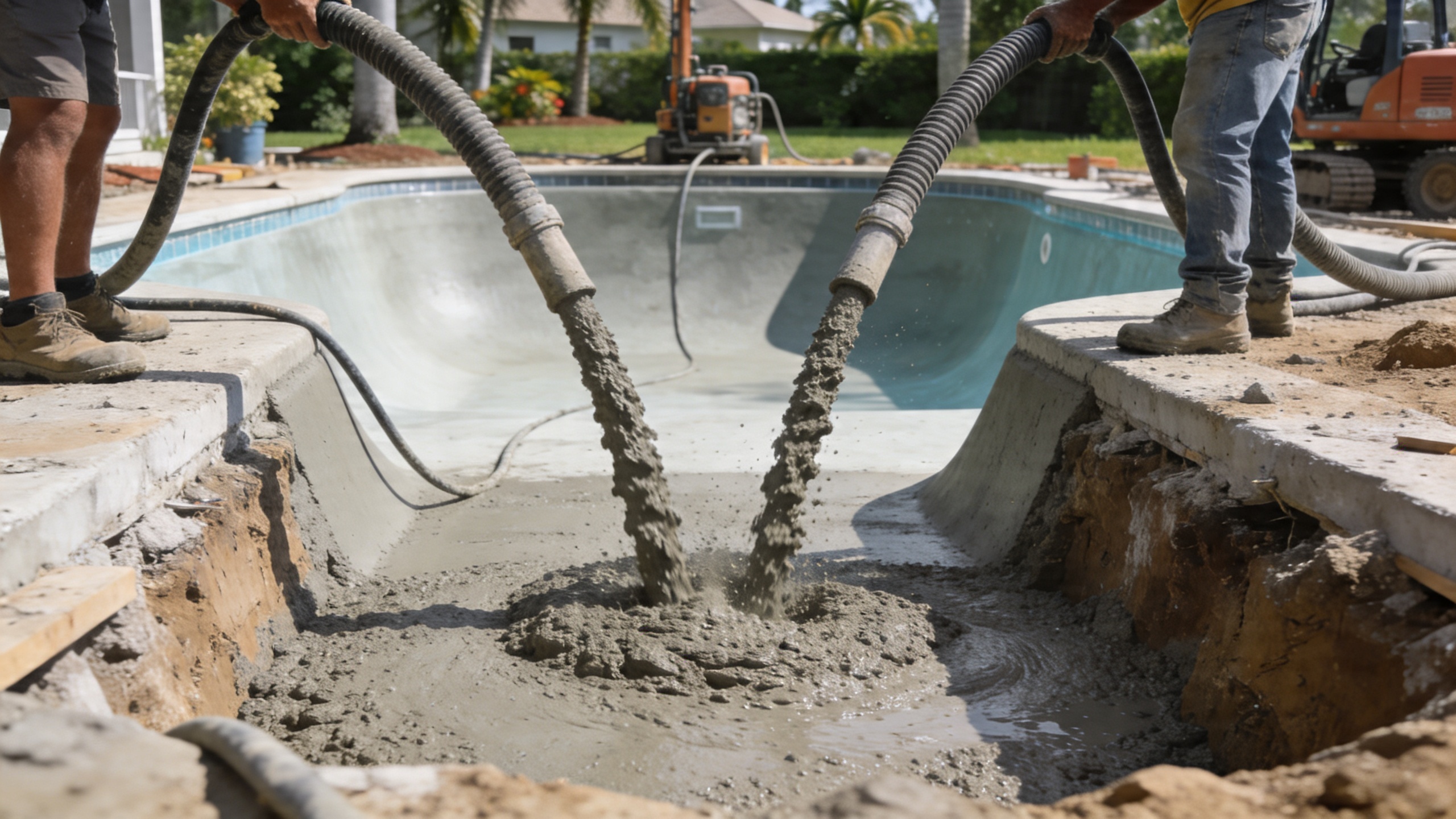
When homeowners ask us what kind of pool we build, we say shotcrete. Most nod and move on. A few ask the right question: what’s the difference?
The honest answer is that most pool contractors and most homeowners treat the two as identical. They’re not.
What is Shotcrete?
Shotcrete is a concrete application method where a pre-mixed wet concrete blend is pneumatically applied through a hose at high velocity. The mix is prepared before it reaches the nozzle, which means consistent water-to-cement ratio, consistent density, and consistent strength across the entire shell.
What is Gunite?
Gunite is also a pneumatic concrete application method, but the mixing happens at the nozzle. Dry cement and aggregate travel through the hose separately and combine with water at the point of application. The operator controls the water ratio manually, which introduces a variable that does not exist in shotcrete.
How They Compare
| Factor | Shotcrete | Gunite |
|---|---|---|
| Mix type | Pre-mixed wet | Dry, mixed at nozzle |
| Density | Higher, fewer voids | Variable, depends on operator |
| Void risk | Lower | Higher if water ratio is off |
| Florida soil performance | Excellent | Good when properly applied |
| Strength consistency | Uniform | Operator-dependent |
| Industry adoption | Growing | More common historically |
Why Acqua Bella Uses Shotcrete Exclusively
We made the decision to build exclusively with shotcrete for one reason: Florida ground moves.
Pasco County and Hillsborough County sit on limestone karst geology. The soil shifts. Sinkholes form. Summer heat cycles create expansion and contraction stress. A pool shell in this environment needs to be as dense and void-free as possible, because voids become cracks, and cracks become problems.
With shotcrete, we know what is going into every shell before it is applied. The mix is engineered, not eyeballed at the nozzle. For every pool we build in Odessa, Wesley Chapel, Land O’ Lakes, and across Tampa Bay, that consistency matters.
Is Florida Different From Other Markets?
Yes. The gunite-favoring narrative that circulates in pool contractor content was largely written for markets with stable, clay-heavy soils, not Florida’s karst limestone. A pool built to Arizona or Texas soil standards, applied with dry-mix gunite by an average operator, performs differently in Florida’s ground conditions.
We are not saying gunite pools fail in Florida. Plenty of gunite pools have performed well for decades here. We are saying that when you have a choice, you choose the method with fewer variables, and shotcrete is that method.
Do PSI Numbers Actually Matter for Florida Pools?
Both methods exceed what Florida Building Code requires for residential pool construction, so PSI alone should not drive your decision. A properly applied gunite shell can reach 4,000 to 7,000 PSI compressive strength. A well-batched shotcrete mix typically targets 3,000 to 5,000 PSI. Either range is structurally adequate for a residential pool in this region.
What actually determines long-term structural integrity in a Tampa Bay pool is the combination of three things: rebar schedule, shell thickness, and concrete coverage over the steel. We shoot to a minimum 6-inch shell thickness on walls and 8 inches on the floor. Those numbers exceed code minimums and give us the structural margin to stand behind our warranty long-term. Ask every contractor you interview to put shell thickness, rebar spacing, and concrete PSI in writing before you sign anything.
What Florida’s Soil and Climate Do to Concrete Pools
Florida’s clay and sand soil profiles can carry elevated sulfate concentrations. Standard Portland cement is vulnerable to sulfate attack over time, which is why we spec sulfate-resistant mix designs when soil reports indicate elevated levels. Salt air in coastal Pinellas County communities also degrades pool structures differently than inland conditions. Bond beam connections, deck attachments, and coping details all need to account for that environment. If a contractor is not pulling a soil report or asking about local soil conditions on your specific lot, that is a gap in their process regardless of which spray method they use.
Permits, Inspections, and Title Protection
Florida Building Code Chapter 454 approves both gunite and shotcrete construction methods, and Hillsborough, Pinellas, and Pasco county permit offices accept either. Custom pool projects require engineering plans signed and sealed by a licensed engineer, barrier compliance documentation, and inspections at the steel stage, shell stage, and final completion.
We pull all permits in-house and schedule every inspection in sequence. An unpermitted pool or a missed inspection can create real title problems when you sell the home. Florida title companies and buyers’ attorneys look for closed pool permits during real estate transactions, and missing inspections can force you to demolish or retroactively re-inspect finished work. That situation is entirely avoidable when your contractor handles permitting correctly from the start. Our pool permits resource page walks through what is required in the counties we serve.
What Homeowners Get Wrong When Comparing Bids
The most common mistake Tampa Bay homeowners make is treating “gunite” or “shotcrete” as a quality signal when the real differences are buried in the specs. Here is what to watch for across contractor quotes:
- Missing shell thickness specs. If the proposal does not state wall and floor thickness in writing, ask. If they cannot answer, walk away.
- No rebar schedule. Ask what size rebar they use and at what spacing on walls versus the floor.
- Permits listed as “TBD” or “additional cost.” Permits should be built into the contract, not treated as a surprise line item.
- No soil consideration. A contractor who does not mention water table, soil type, or sulfate exposure has not thought through your specific site.
- Equipment brand ambiguity. Get the brand and model numbers for the pump, filter, controller, and any heater or salt system in writing.
The price gap between bids usually is not gunite versus shotcrete. It is shell thickness, rebar schedule, equipment tier, and what the contractor is quietly leaving out of the contract.
Frequently Asked Questions
Is shotcrete more expensive than gunite? Not meaningfully. The material cost difference is negligible at our scale. Any contractor quoting significantly more for shotcrete vs. gunite is pricing based on their equipment preference, not material cost.
Which lasts longer, shotcrete or gunite? A properly applied gunite shell and a properly applied shotcrete shell will last decades. The practical difference is in “properly applied.” Shotcrete removes the operator variable at the mixing stage.
Can you tell the difference from inside the pool? No. Once finished with Pebble Sheen or PebbleTec, the interior surface is identical. The difference is entirely in the structural shell you never see.
Ready to see what your pool would cost? Use our free instant estimator to configure your size, decking, and features and get a price range in under 2 minutes.
Ready to start your pool project?
Get a personalized price range in under 60 seconds.